My silent teachers: life lessons from limpets


At the end of November last year, I finally managed to photograph a particular limpet I’ve been visiting from time to time. Tide, weather, light, camera and heart aligned to create these shots of my companion and his/her home shore. I’ve paired them with an excerpt from my field journal of a mid summer visit earlier this year:
Field notes, Wednesday 2nd July 2025
I pulled myself down to a favourite beach, head trailing my troubled heart and reluctant body.The will of knowing the spectacular effect of this place, and a seat among limpets guided me on.
Sea hares in a pool. Slippery and dark with long, perky rhinophores, engulfing leaves of sea lettuce with their folds. Two in a stack, one getting a ride (so to speak), as the other munches on thin weeds. They like the transparent leafy ones.
Sea hares are a type of sea slug and take on the colour of the seaweed they eat. They are simultaneous hermaphrodites and form mating stacks. Each acts as a male to the one below and a female to the one above. How accommodating! We only have to look at the natural world to realise that our traditional heterosexual view of the world has been wrong all along. Here sexuality is fluid, with many examples of sequential hermaphroditism (sex change) homosexuality and same sex companionship.

I take my seat beside the limpets on a big rock slab. There’s one individual in particular I’d come to visit. I know his spot on the shore, his unique shape. How old are you? Your shell looks ancient, tall with the apex worn shiny and smooth, and swirling layers spilling down the slopes of your cone. You are a mountain marked on a map with contour rings circling your shell. I cannot imagine the storms you must have weathered, clamped to this rock. It’s possible you’ve seen 10 or 20 winters alone, out in the open. I’m sure you had neighbours over the years but they are long gone. There’s no sign of them now, not even a ghostly ring to mark their spot.
You sit quiet and resilient, with solitude and grace, a survivor. Too big for any bird to tackle. Too strong, too streamlined to get dislodged by waves. Perhaps one day a storm will hurl a boulder at you, or entropy will weaken your muscular foot, and compromise your sticky mucus. And you’ll get washed from your home scar never to return again. I wonder, do limpets sometimes get lost or decide to move house and voyage to unfamiliar shores?

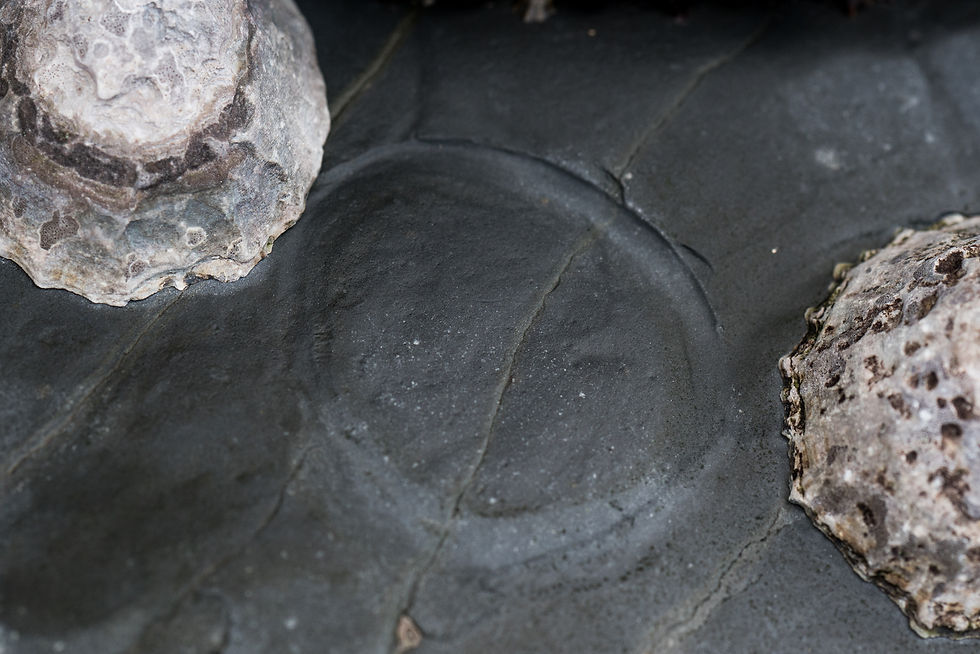


I spend time prone on the slab, staring at their congregations, their shells, the detail of the rims and ridges, so perfectly crafted, so sculpted to the rock. A slow and meticulous molding of shell to stone, and stone to shell. The soft nature of the shale here yields to the grind of their shells, becoming carved with deep rings. Each is finger-printed to their scar, uniquely fitted to their spot. A customized seat, tailor-made by their own shell. On harder rock the shell is carved by the rugosities of the substrate, a slow jigsawing so that they fit neatly to the relief of their chosen home niche. I imagine the clunk-click as they slide and slot into place, to sit out another retreat of the tide, or rise of the sun. In darkness they lift and venture out of their lock to graze. To lick and scrape, gorging limpet-style on algae.
When it’s time to leave, I bid farewell to the limpets and promise to visit again soon, more as a resolve to myself. I climb the steep path to the cliff top feeling calm and renewed, courtesy of this special place and time among limpets.


Comments